TuffHead™ - Behind the Design
|
|
We saw the need for a better broadhead design after being introduced to Dr Ed Ashby's studies on broadhead performance. These scientific studies have answered questions that archers have had for decades.
While our website is mainly about broadheads, to be effective as a
hunter, it is the entire
arrow and delivery system we must concern our self with. The ultimate
design of our broadhead has taken in consideration all of the factors and results of Dr.
Ashby's studies and conclusions.
A few of Dr. Ashby’s findings are below. To glean the full benefit from his reports,
they
should be read in their entirety and are available on the links on this page.
Do not be daunted by the expansiveness of Dr. Ashby's studies and
reports. They read easily and are filled with information that you can
directly apply to your personal experiences in the field.
Again, we urge you to explore Dr. Ashby's studies. What follows is just some of Dr Ashby's main principles that lead us into broadhead development.
Dr Ed Ashby’s 2009 report on “Terminal Arrow Performance” lists twelve main factors contributing to penetration. The report could also be titled “Twelve Tips to Designing the Best Broadhead and Arrow Setup."
Twelve Main Factors of Terminal Arrow Performance.
Quoting and paraphrasing Dr. Ashby's twelve factors, they are listed in the order of
importance that he has assigned:
1. “Structural Integrity of the entire arrow system is the most important
factor. It applies to every aspect of the arrow, from the broadhead tip and
edge strength to the nock”.
2. Arrow Flight is number two in importance.”You should spare neither effort
nor expense in achieving absolute perfect arrow flight.”
3. A higher FOC is important. The degree of arrow forward of center ( FOC) makes a big difference.
“Above 19 % the penetration gain continues increases as FOC increases”.
4. A higher Mechanical Advantage is important. The higher the mechanical advantage of the broadhead the more pronounced
effect it has on penetration.
5. Shaft-Diameter to Ferrule-Diameter Ratio can be critical. The diameter of
the broadhead should be larger than the arrow shaft
6. Arrow Mass or arrow weight is important.”You should use the heaviest
arrow acceptable trajectory allows.”
7. Broadheads should be Shaving Sharp. A smooth sharp edge is better than a
serrated edge.
8. When considering Shaft Profile, tapered shafts have an advantage.
9. A smooth Broadhead With No Bumps to impede penetration is desirable.”How
gradually and smoothly the broadheads ferrule fades into the blade becomes a
major penetration factor when heavy bone is hit.”
10. The Type of Edge Bevel is important.”When broadheads, identical in all
aspects except edge-bevel, are tested side by side on identical arrows,
single-bevel versions demonstrate penetration increases in 100% of cases
involving bone impact”
11. When discussing Tip Design Dr. Ashby believes “the Tanto shows the best
performance”
12. Arrow Mass or weight probably has little effect in soft tissue. However,
there is
a significance difference if bone is encountered.
Keep in mind the "Twelve Principles" when reading about
the TuffHead™ Broadhead.
Compare the details of our TuffHead™ against the Ashby factors.
We have tried to adhere to these factors when
designing the TuffHead™, and you can see that in the TuffHead™ details below.
Dimensions - Mechanical
Advantage and Angle of Attack Tuffhead™ is double laminated, resistance welded and brazed for strength. Each broadhead receives approximately 18 to 20 spot welds. We refer to them as invisible welds as they are not noticeable in the finished broadhead
and leave no ripples or bulges on the surface of the broadhead.
The brazing, hardening, cryogenic treatment and tempering processes were formulated after 18 months of frustrating and painstaking experimentation.
Our guarded final formula gives the TuffHead™ it desirable and sought after qualities.
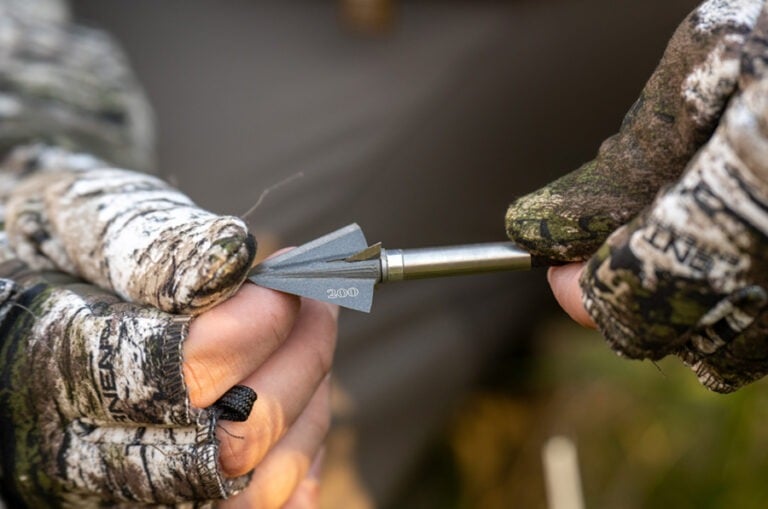
The TuffHead's™ dimensions which are 3 3/16 inches long and 1 1/16 inches wide, makes a perfect three to one ratio
broadhead.
This time tested and proven ratio of 3 to1 provides true and accurate flight, essential for accuracy and penetration. The world renowned archer Howard Hill discovered the benefits of this length to width ratio and incorporated it in his own broadheads.
TuffHead's high mechanical advantage of 3.0+ and its low
angle of attack
of 7 degrees provide the TuffHead™ with maximum cutting surface and penetration capabilities. One can conclude after reading
Dr. Ed Ashby's broadhead studies that
the mechanical advantage of a broadhead is one of, if not the main, contributing factors to penetration. Check out this
YouTube video of an actual
massive bloodtrail made by a TuffHead™ Single Bevel Broadhead from a hunter in Alabama.
The Steel
An exceptional broadhead must be made of great steel. We have
made the TuffHead™ out of 420 HC Stainless steel. This steel is
noted for its toughness and edge retention. The steel along with the hardening and
tempering process is what determines how tough the broadhead is, how well it can be sharpened and how it
retains its’ edge. Being made from high carbon knife grade stainless steel, the Tuffhead™ eliminates corrosion
and rusting, all primary factors in maintaining a good cutting edge. It requires minimum attention
while hunting in harsh wet conditions such as snow and rain. TuffHead’s™ 25 degree single beveled broadheads
are factory sharpened and honed to a fine cutting edge. During sharpening the broadheads are continually
doused with coolant in order to protect the integrity of the 52 Rockwell hardness and cryogenically
treated blade. It is undeniable that the cutting edge of any broadhead is one
of its’ most important
features. It is hemorrhaging or bleeding caused by a good sharp blade that kills an animal shot
by a hunting arrow, not shock as with a bullet from a gun. While the TuffHead’s™ blade is hard
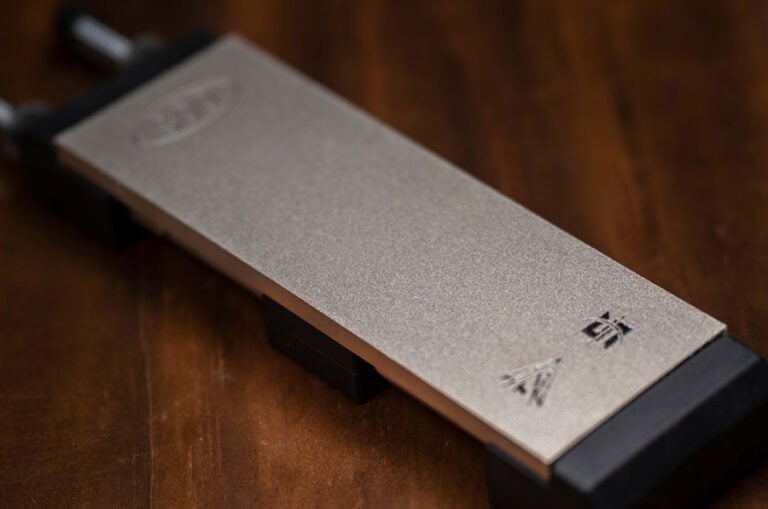
enough to retain its’ keen edge, it can be touched up using a fine stone or leather strop.
(A file
can also be used if required as a last resort. Think of the
TuffHead™ broadhead as a custom knife. Would you use a file on a
custom knife unless it was an emergency?)
Following the already established 25 degree angle the blade can be dressed with a minimum amount
of work.
Read more
on sharpening the TuffHead™.
Single Bevel
It has been shown through many independent experiments that the single bevel
blade configuration found on the TuffHead™ rotates when penetrating the animal. This rotation, characteristic of well designed single bevel broadheads
only, is caused by the pressure of soft and hard tissue on the blade. The rotation creates an enlarged wound channel and with a high mechanical advantage
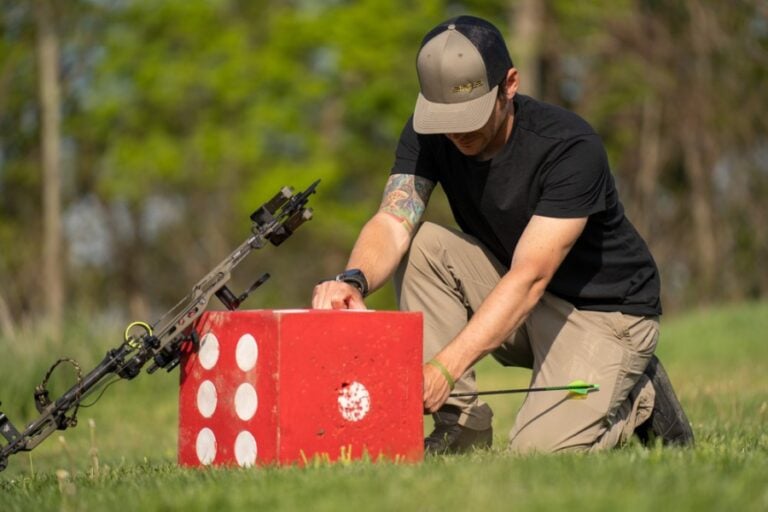
a broadhead such as the TuffHead™ will provide the cutting action and hemorrhaging necessary to insure a kill. Single bevel blade rotation can be demonstrated by shooting a TuffHead™ into a hard, firm, foam target. The rotation can be observed in the cutting
or slicing action of the broadhead in the foam. It also can be seen and felt when the shaft and head are pulled out of the target. The rotation has been demonstrated and discussed by Dr Ashby and other authorities in several articles.
We offer the TuffHead single bevel, 25 degree cutting edge in right and left hand bevels. To insure
the proper rotation of the broadhead shooters using left wing feathers should use a left bevel Tuffhead™. Shooters using right wing feathers
should use a right bevel blade. Attention should be made to broadhead and feather match up. An unmatched set up could retard or negate some of the rotational effects of the single bevel.
See
Selecting the Bevel to assist in determining what your setup
currently is.
Ferrule Design
The 23/64 ID” diameter, 5 degree tapered ferrule, found on the Tuffhead™
accepts arrows from 5/16
inch up to 3/8 inch
in diameter. It is not uncommon for hunters to use large diameter arrows for big game setups. In some circumstances it is the only way to acquire an extremely heavy arrow. Whatever your arrow setup, attention should be given to the arrow and broadhead ferrule diameter dimensions. When the OD of the ferrule is larger than the OD of the arrow, drag is reduced as the broadhead makes an over sized hole or channel for the arrow to follow in. This is a fine
but important detail and it should be added to the list of things that an archer must consider to increase their chances of attaining good arrow penetration.
This arrow and broadhead ferrule diameter dimension was addressed when designing the Tuffhead™. Most arrows do not exceed 3/8 inch OD which is smaller than the OD of the TuffHead ™
The aerodynamic ferrule of the TuffHead™ is designed to extend the full length of the blade to the 30 degree tanto tip. There are no bumps, welds, screws, rivets or vents on the ferrule or blade to catch on tissue or bone which could impede penetration. It is slick with a smooth transition to the tip. The ferrule creates a wedge effect, opening up tissue and cracking bone. Strength is incorporated into the broadhead because of the
unique ferrule design. The full length ferrule provides a stiff convex spine the
length of the blade, resisting any bending or flexing that could spoil any broadheads ability to perform. The length of the ferrule also theoretically concentrates the force of the arrow at the cut-on-contact tanto tip.
When using wood arrows they no longer have to be cut off or shortened at the end of the taper to fit the broadhead.
Because the TuffHead™ ferrule is elongated it will accept a full 5 degree taper on the arrow. It is advantages to have the full length taper on the arrow as it not only adds a few grains of weight up front but helps concentrate the force of the arrow closer to the cut on contact tip.

Broadhead Adapters and Ferrule Design
When using an adapter to convert the TuffHead™ to a screw on model, most adapters regardless of length can be used adding to the versatility of the broadhead. Because the inside diameter (ID) of the ferrule is 23/64 inch adapters of 11/32 inch will fit down in side of the broadhead.
Arrows that screw directly to the broad head and are less than 23/64 inch OD will also fit inside of the ferrule.
This is a designed feature and very desirable and unique detail.
The body of the ferrule creates a sleeve around the arrow tip adding additional strength to a potential weak spot where the broadhead and arrow are joined. If a larger diameter than 23/64 screw on arrow is used it will fit flush with the ferule and provide the same strength as any broadhead without this feature.
The Tanto Tip
The curling of a broadhead tip because it had encountered bone may impede further travel of the arrow through the animal causing wounding and loss of game. The 30 degree tanto tip of the TuffHead™ is designed to be tough and shaped to prevent curling when encountering a hard substance such as bone. The tip is also sharpened
with a double bevel so it cuts immediately on contact
increasing penetration.
Broadhead Weight
The TuffHead™ is the “Heavy Weight of broadheads™“ and is offered in two
distinct weights. At .060 thousandths thick the TuffHead ™ weighs in at
225 grains. At .080 thousandths thick it is 300 grains. Both broadheads
have the same basic dimension that is 3 3/16 long x 1 1/16 wide.
The TuffHead™ is the only broadhead on the market that is designed to
give wood arrow shooters an opportunity to increase their arrow weight
into the desired weight thresholds (over 650 grains) for increased
penetration of both soft and hard tissue. Using the TuffHead™ archers
can create ( FOC ) weight forward of center hunting arrows also
increasing penetration.
The TuffHead also lends itself and has found a niche with modern arrow
enthusiast. When using the TuffHead™ in conjunction with a 75 grain, 100
grain, and a 125 grain steel broadhead adapter, for arrows that except
only screw-on style points, the archer can obtain weights of 300 to 425
grains with many variations in between. With this flexibility the hunter
can experiment and obtain arrows weights that meet FOC, EFOC and Ultra
EFOC standards.
http://tuffhead.com/education/formulas_FOC.html
The TuffHead's™ mass lends itself perfectly to
Weight Forward of Center(FOC)
arrows,
Extreme
Weight Forward arrows(EFOC) and Ultimate Weight Forward of Center
arrows (Ultimate FOC) (see
Dr. Ashby's studies.)
Ceramic Coating
Lastly, a ceramic coating was chosen for the TuffHead™. This coating has a low coefficient of
friction similar to Teflon™ and has been proven, by independent study, to be twice as hard
and more scratch resistant than Teflon™. While it is difficult to measure how much a slick finish contributes
to penetration, many think that it does help. While a finish is not as necessary on stainless steel as it is on carbon steel, we decided to cover all the bases.
We are in favor of anything that may enhance penetration potential
and additionally, the coating gives the broadhead a great look and non-glare finish!
It is these details that we considered important. Read the Ashby studies and decide for yourself!
The TuffHead is overly built so it will be strong and tough enough to hold up against any game encountered. When hunting - “stuff happens.“ Murphy law applies itself regardless of all the hunter's efforts. Even on medium sized game, such as deer, bone is commonly encountered. The hunter can be confident that TuffHead™ will perform and possibly save a less than perfect shot.
When added up, it is the sum of the details that make a great broadhead.
TuffHead™ Broadheads may look similar to other
broadheads, but there is a difference...
and the difference is in the details!
Reference Room
- Dr. Ed Ashby and his Broadhead Lethality Studies
- Ashby .pdf's
- Ashby Jan 2012 Kalamazoo, MI
- Game Animal Anatomy
- Archery Formulas
- Mounting
Broadheads - Selecting the Bevel
- Edge Maintenance
(sharpening) - Tuning the EFOC &
UEFOC shaft - Single Bevel Discussions and Opinions
- Archery
Links of Interest